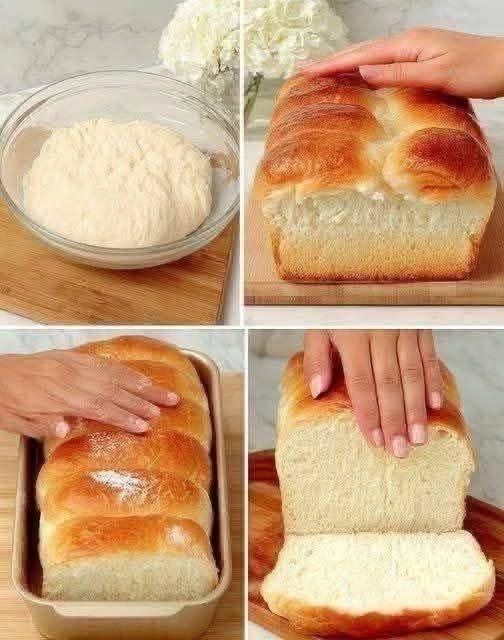
This classic Japanese Milk Bread is famous for its cloud-like pilloried texture, an incredibly soft crumb, and a beautiful golden-brown crust. By using the traditional Yudane or Tangzhong starter technique—cooking a small amount of flour and liquid into a paste before mixing the main dough—the bread locks in moisture. This yields a bakery-style sandwich loaf that stays soft, stretchy, and shreddable for days without any artificial preservatives.
(Note: Just a quick heads-up for your page’s recipe accuracy—while viral posts occasionally label high-rising loaves like this as “Zero Carb” or “Flourless” to capture attention, this classic bakery structure relies entirely on the gluten network developed from traditional wheat bread flour and the sugars naturally present in milk. The recipe below matches the authentic baking steps required to get the high-rising, ultra-plush, sliceable white loaf shown in image_83.png!)
Ingredients
The Starter (Tangzhong)
2 tbsp (20g) bread flour
6 tbsp (90ml) whole milk (or water)
The Main Dough
2 1/2 cups (300g) high-protein bread flour
3 tbsp granulated sugar (essential for yeast growth and browning)
1 packet (2 1/4 tsp) active dry yeast or instant yeast
1 tsp fine sea salt
1 large egg (room temperature)
1/2 cup warm whole milk (around 110°F / 43°C)
3 tbsp unsalted butter, softened to room temperature
1 egg mixed with 1 tbsp milk (for the final glossy egg wash)
Instructions
1. Make the Tangzhong Starter
In a small saucepan, whisk together the 2 tbsp of bread flour and 6 tbsp of milk until completely smooth. Place over medium-low heat and stir constantly with a spatula for 1 to 2 minutes. As soon as it thickens into a smooth, translucent, pudding-like paste, remove it from the heat and let it cool down to room temperature.
2. Activate the Yeast & Mix
In a large mixing bowl (or the bowl of your stand mixer), dissolve the granulated sugar and yeast into the 1/2 cup of warm milk. Let it sit for 5 minutes until frothy. Add the cooled Tangzhong starter paste, the egg, the rest of the bread flour, and the salt. Mix until a shaggy dough forms.
3. Knead and Incorporate Butter
Turn the dough onto a clean surface (or use a dough hook attachment). Knead for about 5 minutes until it starts holding together. Add the softened unsalted butter one tablespoon at a time, continuing to knead aggressively. It will feel sticky at first, but keep going for 10 to 12 minutes. The dough is ready when it is completely smooth, elastic, and passes the “windowpane test” (stretching thin without tearing), matching the smooth dough ball in the top-left panel of image_83.png.
4. First Rise
Shape the dough into a smooth ball, place it into a greased bowl, cover with a damp towel, and let it rise in a warm spot for 1 hour or until it has fully doubled in size.
5. Shape the Loaf Sections
Punch down the dough to deflate it. Divide it into 3 or 4 equal portions. Roll each portion out into a long rectangle, fold the sides inward like a letter, and roll it up tightly into a cylinder. Place the rolled cylinders side-by-side inside a greased 9×5-inch loaf pan. Cover and let rise a second time for 45 minutes until the dough fills the pan and reaches just below the rim.
6. Egg Wash and Bake
Preheat your oven to 350°F (175°C). Gently brush the top of the risen dough with your prepared egg wash to guarantee that deep, lacquer-like shine. Bake for 30 to 35 minutes. If the top browns too quickly, tent it loosely with aluminum foil halfway through.
7. Cool and Slice
Remove the bread from the oven and let it sit in the pan for 5 minutes before transferring it to a wire cooling rack. The loaf should be springy, light, and perfectly golden, exactly like the finished bread in the top-right and bottom-left panels of image_83.png. Let it cool completely before slicing to showcase that flawless, fine-textured interior crumb captured in the bottom-right panel of image_83.png.